
Last Updated: November 1, 2026
Quick Summary
To break in baseball gloves fast without ruining them, combine playing catch, pocket shaping, and a small amount of leather conditioner. Skip heat, water, and microwave shortcuts that dry out and weaken the leather. Two short daily sessions beat one long one.
- Apply a thin coat of leather conditioner or neatsfoot oil only to the pocket and hinges.
- Pound the pocket and hinges for 5 to 10 minutes, then wrap a ball in place overnight.
- Three to five overnight wrap cycles produce a noticeable pocket.
- Stiff premium leather may need five to seven wrap cycles to hold its shape.
- Never soak the leather, and wipe off any excess conditioner with a towel.
Table of Contents
- The Fastest Safe Way to Break In Baseball Gloves
- How to Break In a Baseball Glove Without a Mallet
- How to Shape a Baseball Glove Pocket
- The Best Oil for Breaking In a Baseball Glove
- How Long Does It Take to Break In a Baseball Glove
- Shop the Drop and Get Your Glove Game-Ready
- Frequently Asked Questions
The Fastest Safe Way to Break In Baseball Gloves
Most players ruin a good glove trying to speed up the process. Heat, water, and microwave tricks soften leather fast but dry it out and weaken the fibers for good. This guide shows you how to break in baseball gloves fast the right way: steady work, correct technique, and patience.
The fastest safe method combines playing catch, pocket shaping, and a small amount of leather conditioner. Skip shortcuts that damage leather.
What You'll Need Before You Start
Gather these before you touch the glove:
- A baseball or two (three baseballs help for pocket work)
- A glove mallet or a wooden bat you don't mind using
- Leather conditioner or neatsfoot oil
One note on conditioner: less is more. A thin coat goes a long way, and too much oil makes leather heavy and floppy.
How to Break In a Baseball Glove Without a Mallet
You don't need a mallet to break in a glove. Playing catch is the safest, most reliable method and builds feel at the same time. A mallet speeds up pocket work, but your hands and a baseball do most of the real work.
The Playing Catch Method
This is the method we recommend first: simple, safe, and it teaches you how the glove actually closes.
- Put the glove on and catch lightly for 10-15 minutes.
- Focus on catching the ball in the pocket, not the palm or web.
- After each session, squeeze the glove closed around the ball.
- Repeat daily. Two short sessions beat one long one.
- Store the glove with a ball in the pocket to hold its shape.
According to Better Baseball's glove break-in guide, wearing the glove and playing catch as much as possible is the easiest and most fail-safe approach.
MLB's guide to how players break in gloves notes that players use many methods, from hot water to mallets to freezing.
How to Shape a Baseball Glove Pocket
Pocket shaping is where most players rush and most gloves end up wrong. The pocket is the deep spot between the thumb and fingers where the ball lands.
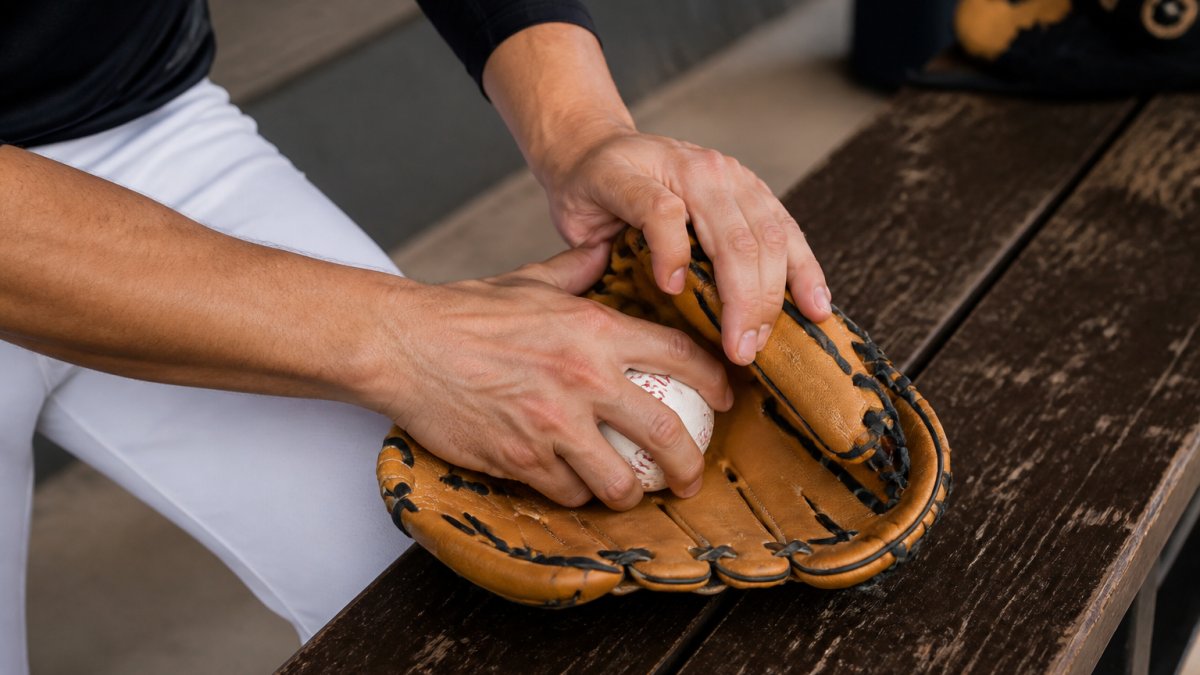
The Core Pocket-Shaping Steps
- Place a ball in the pocket and close the glove around it. Use a game ball, not a rubber training ball, so the pocket forms to real dimensions.
- Press hard along the hinges, the creases where the glove folds. These are the thumb-to-pinky crease and the finger-to-palm crease.
- Use a mallet or the heel of your hand to pound the pocket firmly for 5 to 10 minutes. Work in circles around the pocket, not just the center.
- Wrap the glove with rubber bands or glove string around the ball, keeping the ball seated in the pocket.
- Let it sit overnight, then repeat. Three to five overnight cycles produce a noticeable pocket.
The hinges matter most. A glove that folds in the wrong spot will fight you every time you catch.
How Pocket Shaping Changes by Position
- Infield glove. Keep the pocket shallow and the hinges tight. A deep pocket slows transfer, and infielders need to find the ball and release it quickly. Shape with a single ball and avoid over-wrapping.
- Outfield glove. A deeper pocket helps secure fly balls at the wall. Use two balls wrapped together for the first overnight cycle to encourage depth, then switch to one ball.
- Catcher's mitt. Do not shape a catcher's mitt like a fielder's glove. The pocket should break in around the receiving area, and the hinges should stay stiff enough to protect the hand. Use a mallet lightly and avoid heavy wrapping, which can distort the mitt's structure.
How Leather Type Affects Shaping
- Stiff, premium leather. Expect to repeat the wrap cycle five to seven times. The leather resists the fold longer, but it holds the shape better once it sets.
- Soft or pre-oiled leather. Two or three cycles may be enough. Over-wrapping soft leather can stretch the pocket out of shape, so check the fit after each overnight cycle.
- Synthetic or youth leather. Shape gently and avoid heavy mallet work, which can crack the surface. Hand pressure and a ball in the pocket overnight are usually sufficient.
How Glove Size Affects Shaping
A smaller glove has less leather to work, so the pocket forms faster but can over-stretch if wrapped too tightly. A larger glove needs more deliberate work to keep the pocket centered rather than drifting toward the web. Match the ball size to the glove: a youth glove shapes best around a youth ball, an adult glove around a standard ball.
Common Pocket-Shaping Mistakes
- Wrapping the glove so tightly that the hinges crease in the wrong place
- Shaping only the center of the pocket and ignoring the hinges
- Using water to soften the leather before shaping, which dries it out over time
Do this a few times and the glove starts to hold its shape. Check the fold after every overnight cycle, and adjust the wrap before the leather sets in the wrong place.
The Best Oil for Breaking In a Baseball Glove
The best oil for breaking in a baseball glove is a purpose-made leather conditioner or neatsfoot oil. Both soften leather without the damage water and heat cause. Skip shaving cream, microwave tricks, and soaking the glove.
Where and How Much Conditioner to Apply
Apply a thin coat, and only where the glove needs it most:
- The pocket and hinges first
- A light touch on the palm
- Never soak the leather
A common mistake is over-oiling. Too much conditioner makes the glove heavy and floppy, and it never quite recovers. Two or three thin coats over a couple of weeks beat one heavy soak.
How Long Does It Take to Break In a Baseball Glove
Most gloves need a few weeks of regular catch and pocket work to feel game-ready, but some of the process can be compressed into a few days and some cannot. Knowing which is which keeps you from damaging leather in pursuit of a shortcut.
What Can Be Accelerated
- Pocket formation. A pocket can often be shaped within a few days of repeated ball-and-wrap cycles. The leather memorizes the fold faster when held under pressure overnight.
- Hinge softening. Working the hinges with a mallet or your hands for 10 minutes a day for three days produces noticeable give. This is mechanical softening, not chemical, so it does not dry the leather.
- Initial conditioner absorption. A thin coat works into the leather in a few hours. Two light coats over three days adds suppleness without oversaturating.
What Cannot Be Rushed
- Game feel. Catching a live ball at game speed teaches the glove how to close around impact, and that feedback loop only comes from repetitions. No mallet or oil replicates it.
- Leather memory under stress. A glove that feels broken in on day three can stiffen again after a week of hard use if the fibers were not worked consistently. Plan on several weeks of daily catch to lock in the shape.
- Premium leather. Stiffer, higher-grade leather takes longer than soft leather. Youth gloves often feel ready sooner than stiff adult infield gloves, which usually take longer.
A Practical Fast-Break-In Schedule
Use this as a general guide. Adjust based on how the leather responds.
| Day | Work | Time |
|---|---|---|
| 1 | Thin conditioner coat on pocket and hinges; let absorb; 15 minutes of catch | 30 min |
| 2 | Mallet or hand work on hinges and pocket; wrap around a ball overnight | 20 min |
| 3 | Unwrap; 15 minutes of catch; re-wrap overnight | 20 min |
| 4-7 | Daily catch plus 10 minutes of pocket squeezing; store with ball in pocket | 25 min/day |
| 8-14 | Continue daily catch; add a second light conditioner coat around day 10 if leather feels dry | 25 min/day |
| 15-28 | Play catch at game intensity; check readiness before game use | 25 min/day |
Readiness Checks Before Game Use
Run these tests before you trust the glove in a game:
- The glove closes around a ball without fighting you
- The pocket holds a ball when you set it down
- The hinges fold where they should, not in the palm or web
If any box is unchecked, keep playing catch. It is the safest way to finish the job, and the only way to build the feel a fast break-in cannot fake.
Shop the Drop and Get Your Glove Game-Ready
Breaking in a glove is a test of patience, and the reward is a glove that fits your hand and closes cleanly when it counts. Our limited-run fielding gloves are built for players who want performance and presence on the diamond, with small-batch designs you won't see on every field. Get started with Ballpark Built and break in a glove that's built to perform when it matters.
Frequently Asked Questions
What is the fastest safe way to break in a baseball glove?
The fastest safe route is a combination of repeated catch play, pocket shaping, and a light application of leather conditioner. Playing catch works the hinges and palm naturally, while shaping the pocket by closing the glove around a baseball trains the leather to fold correctly. Break-in time varies by glove and leather type, and premium full-grain leather often takes longer. Avoid water, microwaves, and high heat, which dry out and weaken the leather.
Can you use shaving cream or oil to break in a baseball glove?
Oil and conditioner can help, but shaving cream is not recommended. Use a purpose-made leather conditioner or neatsfoot oil, applying a thin coat to the palm, pocket, and hinges only. Too much oil makes the glove heavy and floppy and can break down the leather over time. Wipe off excess and let it absorb overnight before playing catch again.
How long does it take to break in a new baseball glove?
Break-in time varies by glove and leather type, and premium full-grain leather often takes longer. A realistic fast timeline is several weeks of regular catch play and pocket shaping. Check readiness by seeing whether the glove closes easily around a ball and holds its shape when you open your hand.
How do you shape the pocket of a new baseball glove?
Place a baseball in the pocket and close the glove around it, folding the thumb and pinky toward the middle. Wrap it with string or a strap and let it sit overnight. Repeat this after each catch session. Focus on the hinges and palm so the glove closes the way you field grounders and catches fly balls. Avoid creasing the pocket in the wrong spot, which can create a bad fold that stays.
