
Last Updated: November 13, 2026
Quick Summary
Choosing batting glove colors for your team starts with your uniform's anchor color, the dominant color on the jersey body or helmet shell. Your batting glove colors should repeat colors already visible on the uniform, pulling from a three-color palette of primary, secondary, and accent. Match the helmet before the jersey, since the eye connects them first in the batter's box.
- Photograph your full uniform in daylight and list the two or three colors that appear most.
- Match the glove body to the primary color, the wrist strap to the secondary, and one small detail to the accent.
- Use one accent color, not three, so the eye has somewhere to land.
- Youth gloves should stay two-tone in team colors with no reflective or high-contrast pattern.
- Measure around each player's knuckles with a soft tape and match to the brand's size chart.
Table of Contents
- Start With Your Uniform, Not the Color Wheel
- Baseball Glove Color Rules Every Team Should Know
- Baseball Batting Glove Color Combinations That Actually Work
- Youth Baseball Batting Glove Colors: Keep It Simple
- Ordering Custom Team Batting Gloves Without the Headaches
- Pick Your Colorway and Shop the Drop
- Frequently Asked Questions
Start With Your Uniform, Not the Color Wheel
Most teams pick a glove color they like, then hope it fits the uniform. That is backwards. Choosing batting glove colors for your team starts with the jersey, pants, and helmet you already wear. Sharp teams pick a system, not a favorite color.
Find Your Anchor Color
Your anchor color is the dominant color already on your uniform, usually the jersey body or the helmet shell. Every glove decision answers to it.
Here is how we tell coaches to run it:
- Photograph your full uniform in daylight, jersey to cleats
- List the two or three colors that appear most
- Circle the one on the jersey front
One rule saves a lot of returns: never make the glove the loudest thing on the field unless the whole uniform is built for it.
Baseball Glove Color Rules Every Team Should Know
The core rule is simple: your batting glove colors should repeat colors already visible on the uniform. A glove that echoes the helmet or jersey script reads as intentional; one that introduces a brand-new color reads as an accident. The sharpest teams go further and treat glove color as a small color system, not a single pick.
The Three-Color Rule
Most clean uniforms live on three colors: a primary (jersey body), a secondary (pants, helmet, or sleeves), and an accent (piping, script outline, or logo). Your glove should pull from that same palette. Navy jersey, white script, red piping? Your glove options are navy with white and red accents, not navy with neon green.
Teams that get this right match the glove body to the primary, the wrist strap or logo to the secondary, and one small detail, piping, stitching, or a logo outline, to the accent. That hierarchy keeps the glove from competing with the uniform.
Match the Helmet Before the Jersey
The helmet sits right above the hands in the batter's box, so the eye connects them first. If your helmet is a different color from your jersey, common with team-issued helmets, let the helmet win. The glove-to-helmet link is the strongest visual cue a batter has.
Use One Accent, Not Three
Pick a single contrast color for piping, a logo, or a wrist strap. Restraint separates a clean look from a costume. Three accent colors at once gives the eye nowhere to land.
The Accent Color Wheel for Teams
If your primary and secondary colors are close, say navy and royal, or black and charcoal, you need an accent that separates them. Here is a practical way to choose one without guessing:
- Warm primary (red, orange, maroon): a cool accent like navy, royal, or white creates contrast without clashing.
- Cool primary (navy, royal, teal): a warm accent like red, gold, or white pops cleanly.
- Neutral primary (black, gray, white): almost any accent works, but pick one already on the uniform.
Watch out: an accent color that only exists on the glove, not on the jersey, helmet, pants, or cleats, will read as a mistake no matter how good it looks in the product photo.
Check League Rules Before You Order
Some youth and high school leagues restrict certain colors or require visible contrast between the glove and the ball. The NFHS baseball rules book is the place to confirm what your level allows before anyone spends money. Rules vary by state association and by league, so confirm with your coach or athletic director rather than assuming a color that worked last season still works this season.
Baseball Batting Glove Color Combinations That Actually Work
The combinations that hold up are drawn from your own uniform, not a color wheel. Here are the pairings we see work most often, plus where bold designs earn their place.
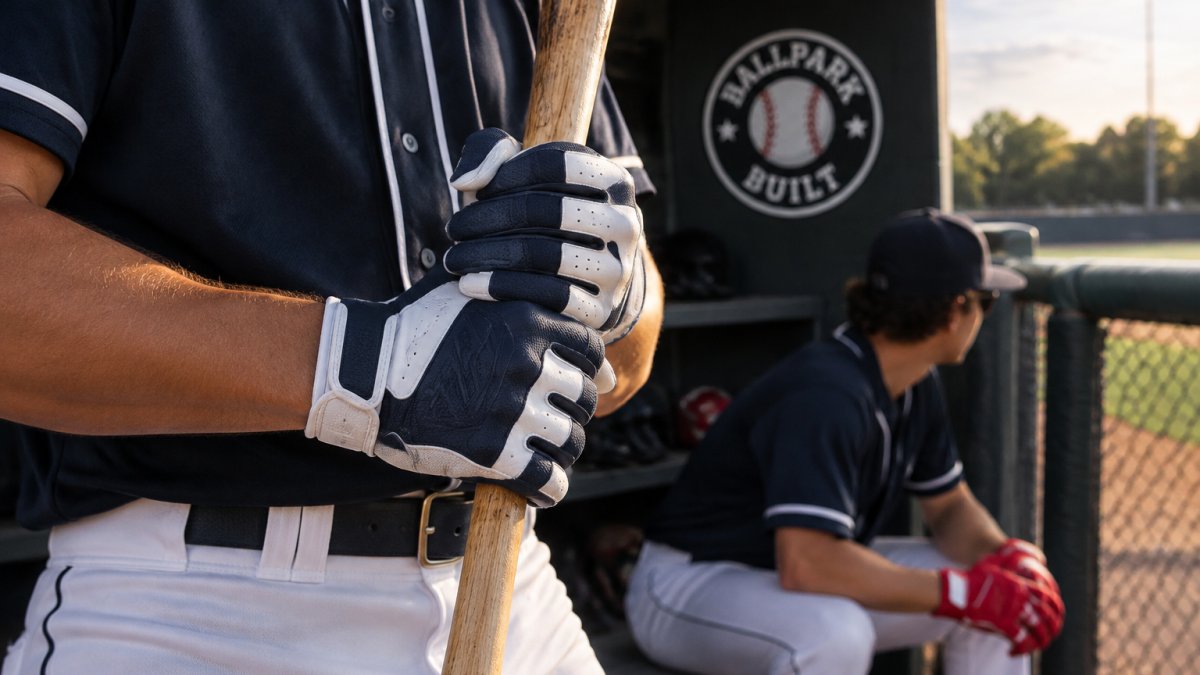
Classic Pairings vs. Bold Patterns
Classic pairings are team-first looks: navy and white, black and gray, red and white, royal and white.
Bold patterns work when the uniform is simple enough to carry them. A white or gray jersey gives a patterned glove room to breathe.
A useful contrast to weigh:
| Approach | Best For | Trade-Off |
|---|---|---|
| Team-matching colors | Full rosters, varsity, travel ball | Less individual expression |
| High-visibility accents | Dugout energy, standout players | Can clash with busy uniforms |
| Classic two-tone | Programs that change uniforms often | Fewer statement looks |
| Bold patterns | Simple uniforms, limited-run gear | Harder to match as a full squad |
If comfort is part of your decision, our breakdown of the 5 best batting gloves for comfort is worth a read before you commit to a colorway.
Youth Baseball Batting Glove Colors: Keep It Simple
For young players, fewer colors win. Youth baseball batting glove colors should stay to two tones that match the team cap or jersey. Kids move between positions and teams, so a simple glove stays useful longer, and it is the safest way to stay inside league rules many parents never check until a coach flags it.
What Youth Leagues Actually Restrict
Youth and high school rulebooks often restrict distracting or deceptive gear. Two restrictions come up most often:
- Ball-color confusion. Some leagues require that a glove not match the game ball closely enough to distract a hitter or pitcher. A pure white or optic-yellow glove can fall into that gray area in stricter leagues.
- Distracting patterns. High-contrast, flashing, or reflective patterns on a glove can be ruled distracting by an umpire, especially in younger divisions where sportsmanship rules are enforced more tightly.
The rulebook language is usually broad, "no distracting equipment", and enforcement is left to the umpire's judgment. The safest youth choice is a two-tone glove in team colors with no reflective or high-contrast pattern. To confirm your league's stance, ask the league director or check your state high school association's adopted rules.
The Two-Team Problem
Young players often play on a travel team and a rec team in the same season, or move up a division mid-year. A glove in a neutral base, black, navy, gray, or white, with a small team-color accent travels between uniforms far better than one built around a loud primary color.
Fit and Grip Beat Flash Every Time
Parents should prioritize fit and grip over flash. Our guide to the best batting gloves for high school covers sizing, grip, and break-in for players moving up a level.
One insider tip: buy two pairs in the same color if your league allows it. Youth gloves take a beating, and a matching backup saves a midseason scramble without forcing a color change that breaks the team look.
Ordering Custom Team Batting Gloves Without the Headaches
Custom team batting gloves go wrong for two reasons: the roster gets sized at the last minute, and nobody confirms the color against a real sample. Fix both before you order.
Start the sizing conversation weeks before your first game, not days. Collect hand measurements for every player on one sheet, note anyone who wants a tighter or looser fit, and confirm the color choice with the head coach in writing.
Sizing the Whole Roster Before You Order
Hand measurement is the step teams skip. Have each player measure around the knuckles of their dominant hand with a soft tape, then match that number to the size chart of the glove you are ordering.
Group orders also need a paper trail:
- One sizing sheet with every player's measurement
- A confirmed colorway and accent color
- A count of left- and right-hand throwers if gloves are hand-specific
If you are ordering for a full squad, our team pricing applies to orders of 12 units or more, and you can request team pricing with your team name, quantity, and the products you want.
Pick Your Colorway and Shop the Drop
Once the anchor color is set and the roster is sized, the fun part starts.
Our premium batting gloves are built with genuine Cabretta leather, with designs made for players who want to stand out. You can shop premium batting gloves in the current colorways, or head straight to Shop the Drop to see what is available right now.
Limited runs mean colors move fast. If your team has settled on a look, lock it in early.
Your uniform already tells you which colors work. The challenge is getting a whole roster sized, matched, and ordered before opening day, and that is where we come in.
Frequently Asked Questions
Can a baseball team wear different batting glove colors?
Yes. Nothing in the standard high school or college rulebooks requires every player to wear identical batting glove colors, so a team can mix and match as long as the gloves don't create a distraction for the pitcher or batter. Most coaches still set a base colorway, like team navy or black, and let players add personal accents. That approach keeps the roster looking coordinated in team photos while giving each player room to express some individuality at the plate.
What is the MLB rule about glove color?
MLB rules bar pitchers from wearing white or gray gloves, or any glove the umpire decides is distracting, because those colors can blend with the ball and the uniform. Position players have more freedom, but umpires can still rule a glove distracting. For youth, high school, and amateur leagues, check your league's rulebook directly, since local rules on glove color vary and some associations add their own restrictions on top of the national rulebook.
How do you match batting gloves to a baseball uniform?
Pull two or three colors straight from your jersey, pants, or cap and treat one of them as the anchor color for the whole roster. A navy and white uniform, for example, pairs cleanly with navy gloves and white accents, while a team in red and black can lean on black gloves with red stitching. Keep the accent color consistent across the squad so the gloves read as part of the uniform rather than an afterthought.
Should youth baseball teams choose matching batting gloves?
Matching gloves help youth teams look organized and cut down on lost-gear arguments, but full uniformity matters less than fit and comfort at that age. Pick one simple, high-contrast colorway the whole roster can wear, confirm every player's hand measurement against a size chart, and let kids add a small personal touch if the league allows it. Fit and feel come first; the color coordination is the bonus.
