
Last Updated: November 21, 2026
Quick Summary
To choose fielding gloves, start with your position: infield gloves need a shallow pocket and quick-transfer web, while outfield gloves need a deeper pocket and more reach. Then match web type, leather, and a secure fit to how you actually play.
- Infield gloves keep the pocket shallow so the ball sits near your palm for a fast transfer.
- Outfield gloves use deeper pockets and open or woven webs so you can track fly balls.
- Pitchers and catchers need closed or solid webs to hide the grip and add structure.
- Measure hand length and width, then compare to the manufacturer's chart, not your age.
- Full-grain leather molds to your hand and can be relaced or repaired; synthetic usually cannot.
Table of Contents
- Start With Your Position, Not the Price Tag
- Different Baseball Gloves for Different Positions
- Web Types Explained: Open, Closed, and Everything Between
- How to Measure Hand for Baseball Glove Sizing
- Baseball Glove Size Chart by Age and Level
- How to Size a Baseball Glove for a Kid
- Leather vs. Synthetic: What Lasts and What Doesn't
- The Fit Checklist: What a Secure Glove Actually Feels Like
- Break-In, Care, and Buying Online Without Regret
- Find Your Glove and Get to Work
- Frequently Asked Questions
Start With Your Position, Not the Price Tag
Knowing what to look for in fielding gloves starts with one question: where do you play? Position dictates pocket depth, web style, and size more than brand loyalty or budget ever will.
A shortstop and a left fielder can hold two gloves that look similar and feel completely different in the hand. One needs a shallow pocket for a fast transfer. The other needs depth to swallow a fly ball at full sprint. Buy for the wrong position and no amount of break-in time fixes it.
Below, we'll walk through position, size, webbing, materials, fit, and care, so the glove you order is the glove you keep.
Different Baseball Gloves for Different Positions
Different baseball gloves for different positions differ mainly in pocket depth, web style, and overall size. Infield gloves favor quick hands, outfield gloves favor reach, and the three specialty gloves (first base, catcher's, pitcher) each solve a specific problem the others can't.
Infield Gloves: Shallow Pocket, Quick Transfer
An infield glove is built for speed, not size. The pocket stays shallow so the ball sits near your palm, which shortens the time between catch and throw on a double play. Middle infielders typically want the smallest glove they can control comfortably; third basemen often go slightly larger to handle hot shots.
For a deeper look at how position shapes the pick, our guide on how to pick baseball gloves for different positions breaks it down spot by spot. If shortstop is your home, what size baseball glove for shortstop answers the sizing question directly.
Outfield Gloves: Deep Pocket, Long Reach
An outfield glove is a basket, not a vacuum. The pocket runs deeper and the web is often open or woven so you can track a fly ball all the way in and still snag it at the warning track. Extra length helps on balls hit over your head, but too much length slows the transfer on throws back to the infield.
Sizing gets specific here. Our breakdown of what size baseball glove for outfield covers the range by age and level so you're not guessing.
First Base Mitts, Catcher's Mitts, and Pitcher Gloves
A first base mitt is a scooper, not a glove: no individual finger stalls, a deep scooped pocket, and extra length to pull throws out of the dirt. A catcher's mitt is heavily padded with a closed, reinforced web built to absorb pitch after pitch. A pitcher's glove hides the grip, which is why the web is almost always closed or solid.
Web Types Explained: Open, Closed, and Everything Between
Web style decides how much of the ball you can see, how fast the ball leaves the pocket, and how well you can hide your grip. Most guides list web types and stop there. The real question is which web matches the plays you actually make. Here is how web choice maps to play type, not just position.
Ground Balls and Transfers
A shallow pocket plus an open or single-post web gives you a clear view of the ball and a short path from catch to throw. Middle infielders turning double plays benefit most: the ball sits near the palm, and the web doesn't trap it deep. An I-web or single-post web is the classic choice here because it is light and lets the ball release quickly.
Watch out: a deep, closed web on a middle infielder's glove can swallow the ball on a backhand and slow the transfer just enough to lose the runner at first.
Fly Balls and Reach
Outfielders want a web that lets them track the ball all the way in and still snag it at full extension. An H-web or basket web gives visibility and structure, and the deeper pocket holds the ball on a sprinting catch. The web also adds stability on balls hit over the head, where a floppy web can let the ball pop out.
Hiding the Grip
Pitchers and catchers use closed or solid webs for one reason: the hitter can't see the grip. A closed web also adds structure and padding, which helps a catcher absorb pitch after pitch. If you pitch, a closed web is not optional; it is part of the position.
Web Types at a Glance
| Web Type | Best For | What It Does |
|---|---|---|
| Open web | Outfield, middle infield | Lets you see the ball in |
| Closed web | Pitcher, catcher | Hides grip and adds structure |
| I-web | Infield | Light, quick transfer |
| Basket web | Utility, youth | Forgiving and flexible |
| H-web | Outfield, third base | Stable with good visibility |
Matching Web to Play Style
If you play multiple positions, a utility web like a basket or modified H-web gives you flexibility without sacrificing too much visibility or structure. If you are a specialist, pick the web that fits your most common play, not your rarest one. A shortstop who occasionally plays the outfield should still choose an infield web; the glove you use every day matters more than the one you use twice a season.
How to Measure Hand for Baseball Glove Sizing
Measuring your hand for a baseball glove takes two numbers: hand length and hand width. Measure from the base of your palm to the tip of your middle finger, then across the widest part of your palm just below the knuckles. Compare those to the manufacturer's chart, not to your shoe size or your buddy's glove.
A common mistake is buying by age alone. Two 12-year-olds can have very different hands, and a glove that's too big swallows the pocket and kills control.
Baseball Glove Size Chart by Age and Level
A baseball glove size chart by age is a starting point, not a rule. Youth players generally land in smaller gloves, high school and adult players move into full-size patterns, and position shifts the number up or down by an inch or two.
| Age / Level | Typical Infield | Typical Outfield |
|---|---|---|
| Youth (8U-10U) | 9-10.5 in | 10.5-11.5 in |
| Youth (11U-12U) | 10.5-11.25 in | 11.5-12.25 in |
| High school | 11.25-11.75 in | 12.25-12.75 in |
| Adult / college | 11.25-11.75 in | 12.5-13 in |
Typical Infield
Treat the chart as a range. Your hand size and how you play matter more than the number on the box.
How to Size a Baseball Glove for a Kid
Sizing a baseball glove for a kid comes down to control, not room to grow. A young player should be able to squeeze the glove closed with reasonable effort and feel the ball settle into the pocket. If the glove swallows their hand or flaps open when they run, it's too big.
Skip the "buy it big so they grow into it" advice. A glove that's too large teaches bad habits and makes catching harder. Size for the hand they have now.
Leather vs. Synthetic: What Lasts and What Doesn't
Leather wins on durability and feel; synthetic wins on price and out-of-the-box readiness. But the trade-offs go deeper than that, and they show up in how you maintain the glove, how long it takes to break in, and how it feels on your hand in year two versus week one.
Leather: Full-Grain and Kip
Full-grain leather is the top layer of the hide, and it molds to your hand over time. It holds its shape for seasons and gets better with use. Kip leather has a premium feel and is lighter than standard full-grain, but it still benefits from break-in.
A well-cared-for leather glove can last multiple seasons, and leather responds to conditioning, which helps extend its life.
Synthetic: Light and Fast, But Short-Lived
Synthetic gloves are lighter and cheaper, and they are game-ready almost immediately. That makes them a reasonable choice for a young player who is still growing or a casual player who plays a few times a month. The downside is feel and longevity: synthetic never develops the custom pocket of leather, and it tends to break down faster under regular use.
Side-by-Side Trade-Offs
| Factor | Full-Grain Leather | Kip Leather | Synthetic |
|---|---|---|---|
| Durability | High | High | Lower |
| Feel | Molds to hand | Light, premium | Less feel |
| Break-in | Needs work | Needs work | Game-ready fast |
| Maintenance | Condition regularly | Condition regularly | Wipe clean |
| Long-term shape | Holds well | Holds well | Breaks down |
Care and Long-Term Maintenance
Leather needs care to last. Clean off dirt after games, condition the leather a few times a season, and store the glove with a ball in the pocket to hold its shape. Keep it out of extreme heat; a hot car or a microwave dries out leather and cracks it. Synthetic gloves need less care but also can't be revived once they break down.
Watch out: over-conditioning leather can make it soft and floppy, so condition sparingly and let the glove dry naturally.
Signs of Wear to Watch
Lacing that frays, a heel that gapes, or a pocket that won't hold shape are signs the glove is near the end of its life. Leather can often be relaced or repaired; synthetic usually cannot. If you play competitively, leather is the better long-term investment because it can be maintained and repaired rather than replaced.
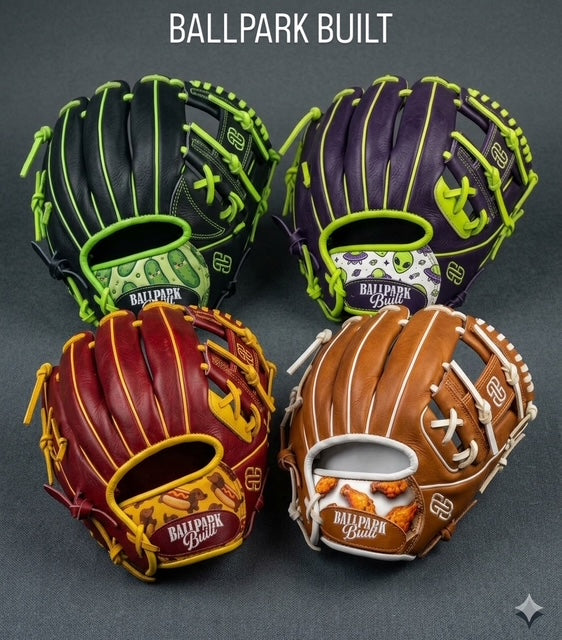
Our Ballpark Built Fielding Glove is made from premium full-grain kip leather, built for everyday use with a game-ready pocket design.
The Fit Checklist: What a Secure Glove Actually Feels Like
A secure fit means your fingers reach the finger stalls, your thumb sits in the thumb slot, and the wrist closure snugs down without cutting off circulation. Run through this checklist before you commit:
- Fingers reach the end of the stalls without curling
- Thumb sits fully in the thumb slot
- Wrist closure tightens without pinching
- You can squeeze the glove closed with moderate effort
- The pocket sits where the ball naturally lands
- No gaping at the heel when you squeeze
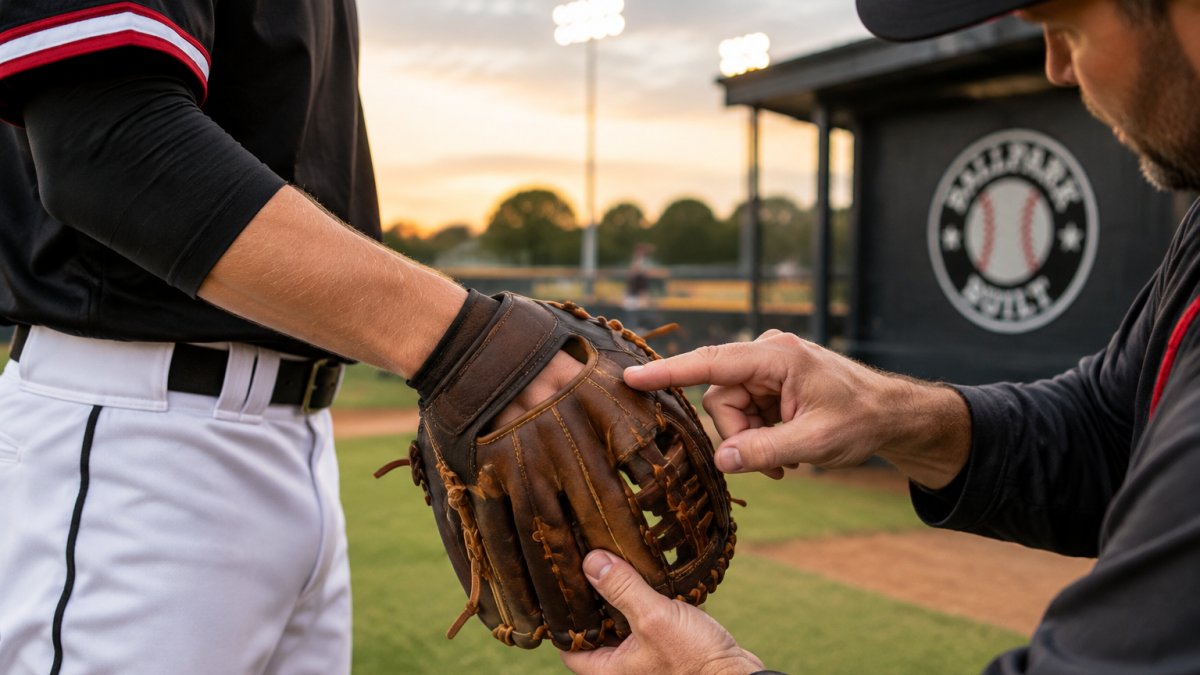
If any box goes unchecked, size up or down before you buy.
Break-In, Care, and Buying Online Without Regret
Break-in and care decide how long your glove lasts. Most leather gloves need some work before game day: play catch, work the pocket by hand, and store it with a ball in the pocket to hold shape. Skip the microwave and the oven; heat dries out leather and cracks it. Our guide on how to break in baseball gloves fast without ruining them covers safe methods that protect the leather.
Buying online adds one more step: check the size chart twice before you order. A glove that doesn't fit right is a glove that never gets used.
Find Your Glove and Get to Work
The right glove disappears on your hand. You stop thinking about it and start reacting to the ball. That's the standard: position-first sizing, a web that matches your game, leather that holds up, and a fit you can trust.
At Ballpark Built, we make limited-run fielding gloves from premium full-grain kip leather, built for serious play and designed to stand apart from what everyone else on the field is wearing.
Get started with Ballpark Built and put a glove on that performs when it matters. Browse the full fielding gloves collection and find your next gamer.
Your glove is the one piece of gear you touch on every single play. Get the position, size, and fit right, and everything else on the diamond gets easier. Ballpark Built builds game-ready fielding gloves in limited runs so you can perform and stand out doing it.
Frequently Asked Questions
What are the best fielding gloves for serious high school players?
The best fielding gloves for serious high school players match position first: a shallow-pocket infield glove for middle infielders, a deeper outfield glove for fly-ball coverage, and a dedicated mitt at first base or catcher. From there, prioritize full-grain leather that holds its shape through a full season, a secure wrist closure, and a pocket that fits your hand. Ballpark Built's fielding glove is built from premium full-grain kip leather with a game-ready pocket, so it suits players who want a glove that performs without a long break-in.
Can an infielder use a 12-inch glove?
Yes, an infielder can use a 12-inch glove, and many do at the high school and adult levels. The trade-off is pocket depth: a 12-inch glove gives a little more room for backhands and line drives but can slow the transfer on double plays compared with an 11.25 to 11.75-inch model. Middle infielders usually stay smaller for quick transfer, while third basemen often go up to 12 inches for reaction time on hard-hit balls. Try both sizes with a ball before committing.
Do you need different baseball gloves for different positions?
You do not need a separate glove for every position, but the glove should match where you play most. Infield gloves have shallower pockets and open webs for quick transfer; outfield gloves run longer with deeper pockets for fly balls; first base mitts and catcher's mitts are built for scooping and receiving; pitcher gloves use closed or solid webs to hide the grip. A versatile glove can cover rec play, but competitive players benefit from a position-specific fit.
How do you measure your hand for a baseball glove?
Measure from the base of your palm at the wrist to the tip of your index finger, then compare that measurement against a glove size chart. Most charts map hand length to glove size, and the number matters more than age for adults. For kids, measure the hand the same way and check that the fingers reach the end of the stalls without curling. A glove that is too big lets the ball rattle around; one that is too small restricts the pocket.
What size baseball glove should an adult use?
Most adult players land between 11.25 and 12.75 inches depending on position. Middle infielders typically use 11.25 to 11.75 inches, third basemen 11.75 to 12.25, outfielders 12.5 to 12.75, and first basemen a 12.5 to 13-inch mitt. Pitchers often prefer 11.5 to 12 inches with a closed web. Hand size and playing style shift the number, so use the chart as a starting point and test the fit with a ball in the pocket.
What is the best type of fielding glove for playing catch?
For casual catch, a versatile 11.75 to 12.25-inch glove with an open web works well for most adults because it handles ground balls and fly balls without being specialized. Kids should use a glove sized to their hand so they can squeeze the pocket and build confidence. Leather quality still matters: a full-grain glove breaks in to your hand and holds its shape, while a synthetic glove may soften too quickly with heavy use.
Are Ballpark Built fielding gloves game-ready out of the box?
Ballpark Built fielding gloves are built with a game-ready pocket design, so they are ready for practice and game day without a long break-in period. Full-grain kip leather still benefits from catch play and light shaping to fit your hand, but you are not waiting weeks to use it. The glove ships the next day and typically arrives 5 to 7 days after ordering, which matters if you are gearing up before a tournament.
How long does team pricing take for a full squad order?
Ballpark Built offers team pricing for orders of 12 units or more, which covers most high school and adult league rosters. Because gloves are produced in small batches, timing depends on the design and quantity, so confirm the schedule before your season starts. Send your roster sizes and positions early so everyone gets a glove that fits.
